The Experimental Particle Physics group at Ghent University has recently been expanded with a group working on high intensity searches for new physics at CERN’s flagSHiP experiment for the matter. The group at Ghent University is developing advanced detector technologies for usage in the SHiP experiment starting 2032 with leading contributions to high-granularity neutrino detectors, which enable the experiment to observe all flavours of nature’s most abundant, but also most elusive particle; background taggers which ensures the experiment is able to certify any observation as being genuine and the experiment’s main calorimeter system which allows the experiment to make said observations.
Physics beyond the Standard Model
New physics beyond our current understanding is known to exist, searches to this day, in particular at high energies, have however not yielded any indication for them. SHiP intends to probe new horizons through very high intensity searches for new physics. Indeed, new physics would have to either be heavier than investigated until now, or too weakly interacting to have been observed.
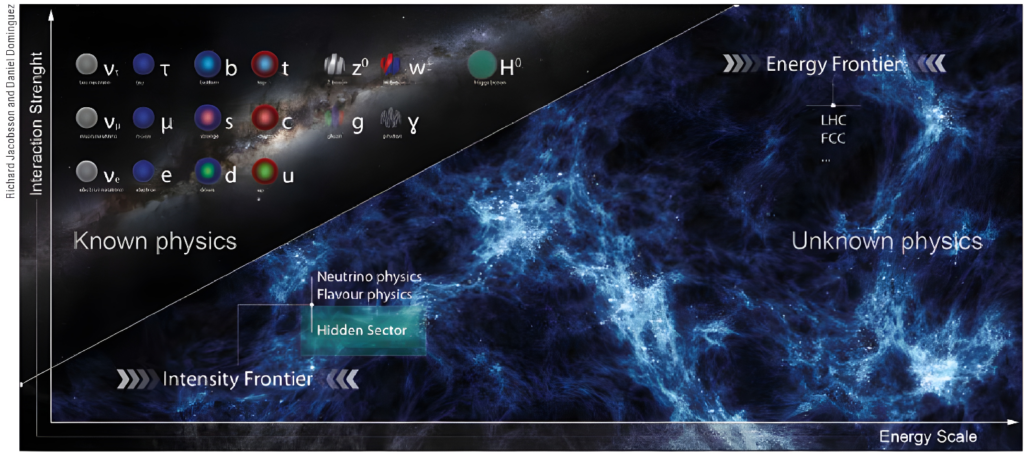
Solutions to the current deadlock may in particular include:
Feebly-Interacting-Particles (FIPs): particles interacting so weakly with ordinary matter that only the highest of intensities could enable any observation.
Hidden sectors: entire families of particles with no direct interaction to ordinary matter and which could only be accessed through “portals”: mediator particles with extremely weak coupling to known physics. These sectors are particularly attractive as an explanation to Dark Matter.
Extra heavy neutrinos: also known as Heavy Neutral Leptons (HNL), these particles, yield an explanation for the lightness of the neutrino. If discovered at SHiP, they would also explain the prevalence of matter over antimatter in the universe and yield a possible explanation as to the nature of Dark Matter.
Axion-Like-Particles (ALPs): Nature is known to be symmetric, leading to conservation laws. Some of these symmetries are known to be broken however, which allows for instance for an overabundance of matter with respect to antimatter in the universe. The breaking of these symmetries yields extra, lighter particles such as ALPs. As new physics may lie far beyond the reach of modern day instrumentation, the search for these particles is the only way to probe sectors with low coupling and high mass.
In addition, SHiP will provide the observation of an abundance of all neutrino flavours, in particular that of the seldom observed tau neutrino (up to 26 observed to this day, over 10 000 expected at SHiP), measurement of interaction cross sections, high-precision probes into the structure of nuclear matter with the measurement of parton distribution functions, the F4 and F5 structure functions, a measurement of Vcd as well as many more.
The experiment
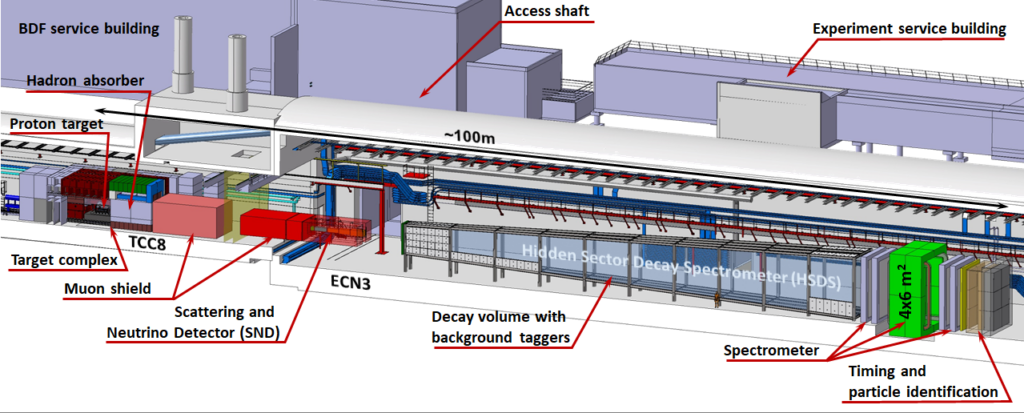
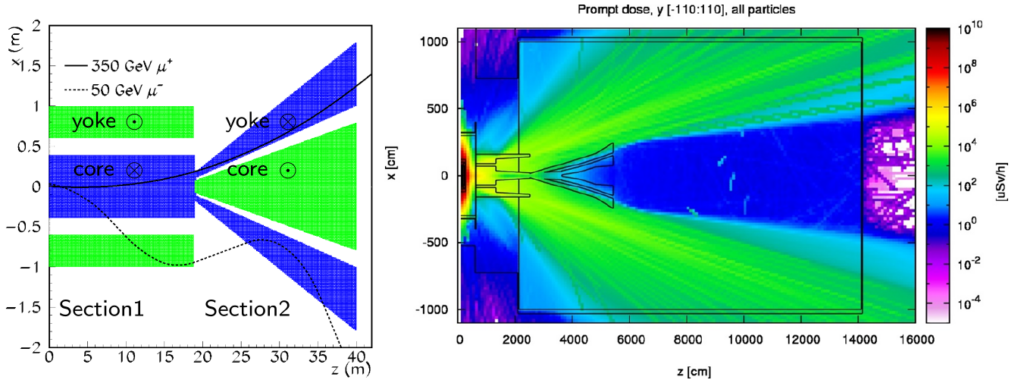
Located at ECN3 in the CERN North Area, the SHiP experiment will be organised as a beam dump experiment: a very high-intensity 400 GeV proton beam will be dumped onto a thick tungsten target so as to maximise charm and beauty production (est. >10¹⁸ and >10¹⁶ respectively over 15 years). The decay products are thus boosted in the forward region and need to be filtered to allow for backgroundless reconstruction of new physics events. This is done through a hadron absorber and an active muon shield: a powerful magnet sweeper meant to create a low radiation zone where a detector system may be placed.
encompassed inside of the final magnet section of the muon shield is the Scattering Neutrino Detector (SND) which will enable the observation of neutrinos thanks to its high precision and granularity. The Ghent university group is contributing towards providing this detector its energy resolution through the use of small scintillator ties traversed by wavelength shifting fibres and readout by silicon photomultipliers.
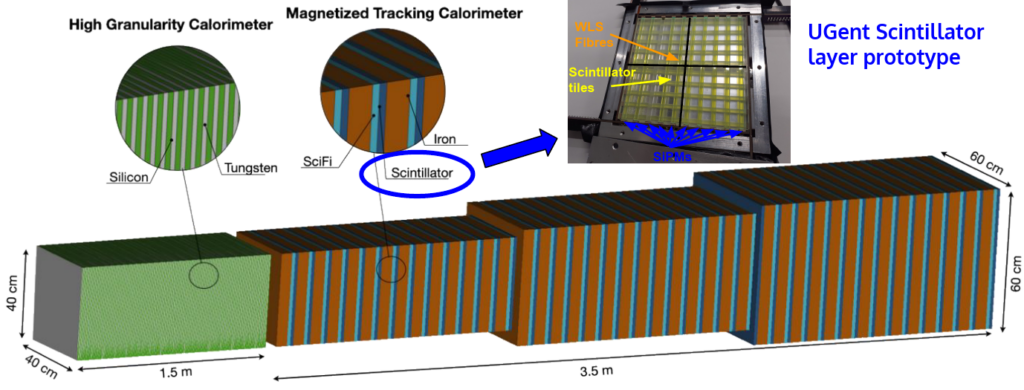
After the SND is the background tagger system which encompass an empty decay volume where new physics may enter and decay. The backgrounds tagger system made of an Upstream Background Tagger (UBT) and a Surround Background Tagger (SBT) which ensure that no particle enters the decay volume without being accounted for. The Ghent University is taking part in the design and optimisation of the UBT.
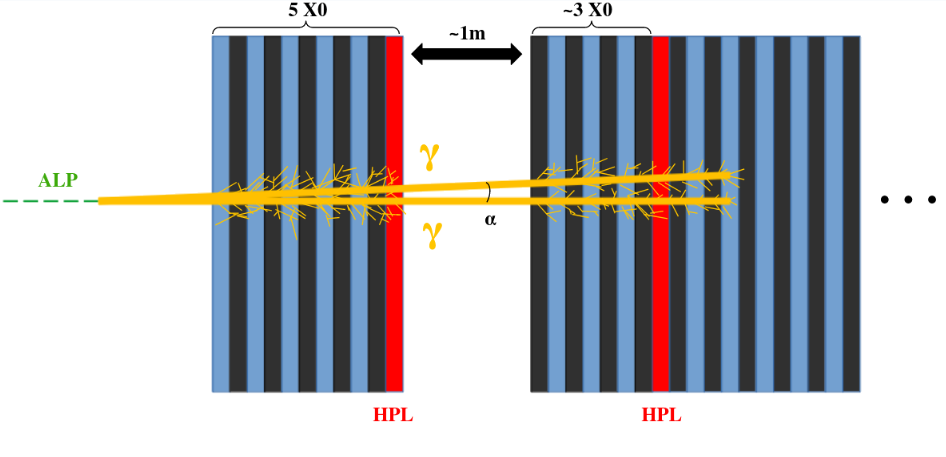
The final section of the experiment is composed of a spectrometer tracker, a timing detector and a calorimeter system. The first is composed of a straw tube detector and a large magnet, enabling the reconstruction of charged decay vertices. The timing detector is meant to ensure that no background is induced by combinatorial particles entering the detector at the same time from separate events. Finally, the calorimeter system enables energy reconstruction, particle identification and vertexing for neutral decays. The Ghent University group is contributing to the latter with emphasis on detector optimisation and the elaboration of High-Precision-Layers based on a novel detector concept conceived in Ghent: the Scintillating-fibre High Accuracy Reconstruction Planes (SHARP) which allow for excellent shower directionality reconstruction to take place.